What Is Textile Weaving and How Does It Work?
Textile weaving is the quiet engineering behind many fabrics we use every day. It joins two yarn systems, the warp and the weft, through controlled interlacing. The warp runs lengthwise under tension. The weft crosses it, row by row. This simple meeting creates cloth with strength, flexibility, texture, and visual rhythm.
Anni Albers, a leading textile artist and educator, wrote, “Design is not a single act but a complex process involving all the elements of the problem.” Her observation remains valuable in modern textile weaving. A weaver must consider yarn thickness, fiber behavior, loom settings, density, and intended use. Cotton may produce a crisp shirt fabric. Wool can create warmth and soft volume. Linen often feels cool, though it may crease easily. Small adjustments can change the entire surface.
The process begins with planning. Designers choose a weave structure, such as plain weave, twill, or satin. The warp threads are then arranged carefully on the loom. Mistakes can appear as loose edges, uneven tension, or unexpected gaps. Sometimes, these flaws reveal useful information. They may also weaken the fabric. That uncertainty deserves attention.
Hand looms offer direct control and visible feedback. Industrial looms provide speed, consistency, and precise production. Both methods depend on knowledge and patience. Textile weaving is not merely the crossing of threads. It is a balance between material, machine, human judgment, and purpose. Understanding that balance makes every finished fabric easier to examine, value, and improve.
Definition and Basic Principles of Textile Weaving
What Is Textile Weaving and How Does It Work?
Definition and Basic Principles of Textile Weaving
Textile weaving is the process of crossing two yarn systems to form fabric. Lengthwise yarns are called the warp. Widthwise yarns are called the weft. The warp stays under controlled tension, while the weft travels across the fabric’s width. Their repeated intersection creates a stable textile structure.
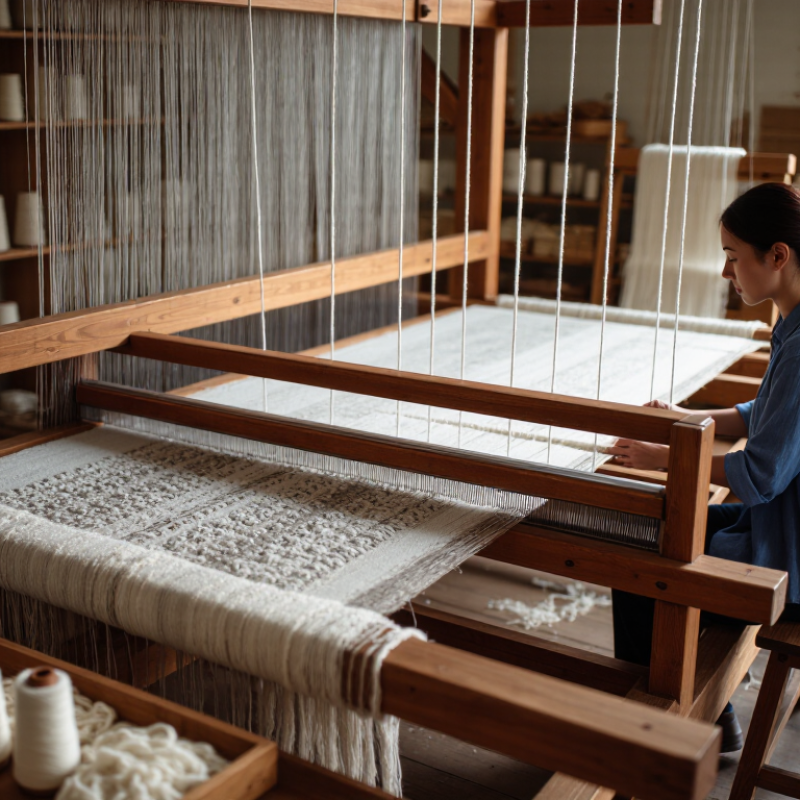
A loom separates warp threads into an opening called the shed. The weft passes through this space by hand or mechanical insertion. Heddles then change the position of selected warp threads. The reed pushes each new weft thread into place. This action is known as beat-up. Small changes in tension can alter the fabric’s width, density, and surface appearance.
Plain weave passes each weft thread over and under alternating warp threads. Twill weave creates diagonal lines through a shifted interlacing pattern. Satin structures produce longer floats and a smoother surface. These floats can catch easily, however. In practical weaving, uneven yarn thickness may create small marks or loose areas. That is not always a defect, but it requires judgment. I have found that careful tension checks prevent many problems before weaving begins. Still, perfect control is difficult. Humidity, yarn preparation, and loom alignment can all influence the final cloth.
Main Materials, Tools, and Loom Components
Textile weaving interlaces two yarn systems: warp threads run lengthwise, while weft threads cross them. Textile Exchange’s Materials Market Report 2024 estimates global fiber production reached about 124 million tonnes in 2023. That scale makes material selection important. Cotton offers softness and breathability. Wool provides warmth and natural elasticity. Linen feels cool, but it can crease easily. Recycled fibers reduce demand for new resources, although quality and traceability still require careful checking.
A loom controls this crossing process through several essential components. The warp beam stores yarn under tension. The heddles lift selected warp threads and create the shed. The shuttle or rapier carries weft yarn through that opening. The reed spaces the threads and beats each pick into place. A beater holds the reed, while treadles or mechanical controls change the shed. Weaving looks repetitive, yet small tension differences can produce ridges, gaps, or uneven edges. My practical mistake was tightening every thread equally; some structures need controlled variation.
Tips: Check yarn strength before warping. Use a ruler to measure sett, or warp density. Keep the shed clean and unobstructed. Record tension settings beside the loom. The International Textile Manufacturers Federation regularly reports continuing investment in automation and digital production, but skilled adjustment remains essential. Machines improve consistency. They do not always recognize a slipping thread. Beginner samples may look imperfect, and that is useful evidence. Inspect the back of the cloth, not only its surface.
How Warp and Weft Threads Form a Fabric
Textile weaving is the controlled interlacing of two thread systems: warp and weft. Warp threads run lengthwise through the fabric. They stay under steady tension on the loom. Weft threads travel across them, passing over and under selected warp threads. This repeated structure creates a stable textile surface.
During weaving, heddles lift specific warp threads and form a temporary opening called the shed. A shuttle or rapier carries the weft through that opening. The reed then pushes the new thread into place. A plain weave alternates one over and one under. Twill changes the pattern, creating diagonal lines and stronger drape. Satin uses longer floats, producing a smoother surface but greater snag risk. Small tension changes can cause visible bars, loose edges, or uneven density. I have found that these faults often appear after finishing, not on the loom.
Industry data shows why this process matters. Textile Exchange reported approximately 124 million tonnes of global fiber production in 2023. That volume increases pressure to reduce waste during yarn preparation and fabric formation. The International Textile Machinery Federation also tracks continuous investment in faster, more automated weaving equipment. Speed helps, but it cannot replace careful setup. A loom running quickly with poorly aligned warp threads simply produces defects faster. Experienced technicians still check thread tension, reed spacing, moisture, and fabric width by hand. The process is precise, though never perfectly predictable.
Common Weaving Structures and Their Visual Effects
Textile weaving interlaces lengthwise warp yarns with crosswise weft yarns. Their crossing pattern controls light, texture, strength, and drape. Textile Exchange’s Materials Market Report 2024 recorded global fiber production at about 124 million tonnes in 2023. That scale makes structure selection commercially important, not merely decorative.
Plain weave crosses each yarn evenly. It creates a firm, crisp surface, often with a quiet matte appearance. Twill moves the weft across several warp yarns, forming diagonal lines. Denim-like surfaces show this effect clearly, while the fabric usually bends more comfortably. Satin uses longer floats, producing a smooth, reflective face. It feels luxurious, but those exposed yarns can snag more easily. Jacquard weaving changes the lifting sequence across the loom. It can build raised motifs, shadows, and complex color blocks without printing. The result is expressive, though sometimes heavier than expected.
Tips: View samples under direct and side lighting. A satin may look elegant indoors but reveal every crease outside. Check both fabric sides. I have seen attractive swatches fail during abrasion testing. Structure alone does not guarantee performance. The Materials Market Report also projects global fiber production could reach roughly 160 million tonnes by 2030, increasing pressure to design longer-lasting textiles. This is where my judgment remains imperfect: visual richness can tempt designers to ignore repairability, yarn waste, or end-use movement. Test the cloth in motion, not only on a flat table.
What Is Textile Weaving and How Does It Work? — Common Weaving Structures and Their Visual Effects
Weaving forms fabric by interlacing lengthwise warp yarns with crosswise weft yarns. The interlacing pattern strongly affects a textile’s appearance, strength, texture, drape, and typical applications.
| Weaving Structure | Basic Interlacing Method | Surface Appearance | Texture and Hand Feel | Drape and Stability | Typical Material Behavior | Common Applications | Visual Effect |
|---|---|---|---|---|---|---|---|
| Plain Weave | Each warp yarn passes over one weft yarn and under the next in a repeating one-over, one-under sequence. | Even, clean, and usually matte; the fabric may show a fine checkerboard effect. | Firm, smooth, and relatively crisp, depending on yarn size and density. | Generally stable with limited stretch and moderate drape. | Resists distortion well, but can crease more readily than some textured structures. | Shirting, lightweight home textiles, canvas, muslin, and linings. | Creates a simple, balanced appearance that highlights yarn color and surface detail. |
| Twill Weave | Warp or weft floats are arranged to create a step-like diagonal progression, such as two-over, two-under. | Visible diagonal ribs or wales running across the fabric. | Usually smoother and more supple than plain weave, with a distinct ridged surface. | Good drape with strong dimensional stability. | Often hides soil and wrinkles better than plain weave because of its diagonal surface. | Trousers, jackets, workwear, upholstery, and durable cotton or wool fabrics. | The diagonal line adds movement, depth, and a directional visual texture. |
| Satin Weave | Long floats are distributed so that adjacent interlacings are separated, minimizing visible binding points. | Usually smooth and lustrous, with a reflective surface. | Soft, sleek, and fluid; the surface can be more vulnerable to snagging. | Excellent drape, but typically less abrasion-resistant than tighter interlacing structures. | Light reflection varies with fiber type, yarn fineness, and finishing. | Eveningwear, linings, decorative textiles, and smooth furnishing fabrics. | Produces a polished, glossy effect by exposing longer yarn floats on the surface. |
| Basket Weave | Two or more warp yarns interlace together with two or more weft yarns as grouped units. | Open, block-like, or grid-shaped surface pattern. | Textured and often slightly bulky, with a relaxed hand. | Moderate drape but less dimensional stability than a tightly packed plain weave. | Can be breathable and visually bold, but may snag or distort if loosely constructed. | Decorative fabrics, casual apparel, towels, bags, and interior textiles. | Creates a larger-scale check or basket pattern that emphasizes structure. |
| Rib Weave | Warp or weft yarns are arranged in groups so that one direction forms pronounced horizontal or vertical ridges. | Distinct raised ribs, either lengthwise or crosswise. | Textured, structured, and sometimes firm depending on yarn thickness. | Usually stable in the direction of the dominant ribs; drape varies by construction. | Can add thickness and durability without requiring a complex pattern. | Shirting, upholstery, structured apparel, and utility textiles. | Adds stripe-like relief and a strong sense of direction to the surface. |
| Herringbone | A variation of twill in which the diagonal direction reverses at regular intervals to form a V-shaped pattern. | Repeated broken chevrons or fishbone-like lines. | Textured and substantial, with the characteristic feel of a twill fabric. | Good drape and stability, depending on yarn type and fabric weight. | Often durable and effective at disguising minor surface irregularities. | Coats, suiting, blankets, upholstery, and heavier woven fabrics. | The reversing diagonals create rhythm, visual depth, and a tailored appearance. |
| Houndstooth | A broken-check design made by alternating groups of warp and weft yarns, commonly using a stepped twill arrangement. | Jagged, repeating checks with contrasting color blocks. | Usually firm or moderately textured, depending on the underlying weave. | Generally stable with moderate drape. | Pattern scale and contrast can be changed by varying yarn groups and colors. | Suiting, coats, skirts, accessories, and decorative fabrics. | Creates a high-contrast graphic pattern with a strong, recognizable edge. |
| Jacquard Weave | Individually controlled warp yarns allow complex motifs, figures, and multi-level patterns to be woven directly into the fabric. | Detailed motifs may appear flat, raised, reversible, or softly contrasted. | Ranges from smooth to richly textured, depending on yarns and pattern structure. | Varies widely; complex designs may produce heavier fabrics with moderate drape. | Patterns are integrated into the construction rather than simply printed on the surface. | Decorative apparel, upholstery, damask-style textiles, and furnishing fabrics. | Supports intricate imagery, tonal contrast, and elaborate surface effects. |
| Dobby Weave | A small mechanical or electronic shedding system creates repeated geometric patterns and textured motifs. | Small-scale dots, stripes, diamonds, or relief patterns. | Often crisp or subtly textured, with compact decorative details. | Typically stable with moderate drape. | Offers more design variation than plain weave while remaining suitable for repeated patterns. | Shirting, dresses, lightweight furnishings, and decorative yardage. | Adds refined texture and pattern without the large, intricate motifs associated with jacquard. |
| Leno Weave | Warp yarns twist around adjacent weft yarns, locking the weft in place and creating an open construction. | Open, gauze-like, and visibly mesh-like surface. | Lightweight, airy, and sometimes slightly crisp. | Good resistance to yarn slippage despite its open appearance; drape is often light. | Allows airflow and light transmission while maintaining useful structural integrity. | Curtains, netting, lightweight apparel, technical fabrics, and open decorative textiles. | Produces transparency, openness, and a delicate geometric mesh effect. |
| Pile Weave | Additional yarns form loops or cut piles that rise above the base cloth during weaving. | Raised, plush, velvety, or looped surface. | Soft, cushioned, and three-dimensional; the pile direction may affect touch and color. | Usually heavier with reduced fluidity compared with flat woven fabrics. | Can provide warmth, absorbency, softness, and visual depth, depending on pile height. | Towels, velvet-like fabrics, carpets, upholstery, and warm textiles. | Creates strong light-and-shadow variation through a raised surface. |
| Double Weave | Two fabric layers are woven simultaneously and may be joined at selected points or connected by shared yarns. | Dense, substantial, and sometimes reversible with contrasting sides. | Full-bodied, warm, and structured. | Good stability and body; drape is usually controlled rather than fluid. | Can create reversible fabrics, pockets, tubular forms, and insulating layers. | Coats, blankets, reversible textiles, upholstery, and structured garments. | Adds thickness, depth, and the possibility of two coordinated surface designs. |
Modern Applications and Developments in Textile Weaving
What Is Textile Weaving and How Does It Work?
Modern Applications and Developments in Textile Weaving
Textile weaving interlaces two yarn systems: warp threads stay lengthwise, while weft yarns pass across them. A loom controls tension, lifting, and insertion with remarkable precision. Modern systems use sensors to monitor broken ends, fabric density, and operating speed. A tiny tension error can create visible bars across fabric.
Modern weaving serves apparel, medical structures, filtration media, protective fabrics, and vehicle interiors. Textile Exchange’s Materials Market Report 2024 reports 124 million tonnes of global fiber production in 2023. It projects about 160 million tonnes by 2030. This growth increases pressure to use recycled inputs, lower-impact fibers, and durable constructions. However, recycled yarns may vary in strength. Mill technicians still adjust settings through experience.
Digital sampling and automated looms shorten development cycles. Three-dimensional weaving creates shaped parts with fewer seams. Conductive yarns support heating, sensing, and health-monitoring prototypes. A 2024 ITMF industry survey reports continuing investment in automation, although uneven demand limits upgrades for smaller mills. The technology is promising. It is not automatically sustainable. Energy use, finishing chemistry, repairability, and fiber separation remain difficult questions. More factory data is needed.
Related Posts
-
Top 10 Textile Weaving Manufacturers for Global Buyers
-
What Is the Best Textile Weaving Machine in China?
-
Top 10 Smit Weaving Machine Features You Need to Know
-
10 Tips for Buying the Right Fabric Machine
-
7 Best Textile Weaving Machines for Global Buyers
-

2026 Best Fabric Weaving Machine Options for Quality Production?